


The Ghosts of Rosewell Plantation Ruins: History and Mystery in Virginia

If you enjoy this blog post, consider subscribing to get my newsletter.
Comments are always welcome and appreciated.
The first thing that makes Rosewell feel different is how much is gone.
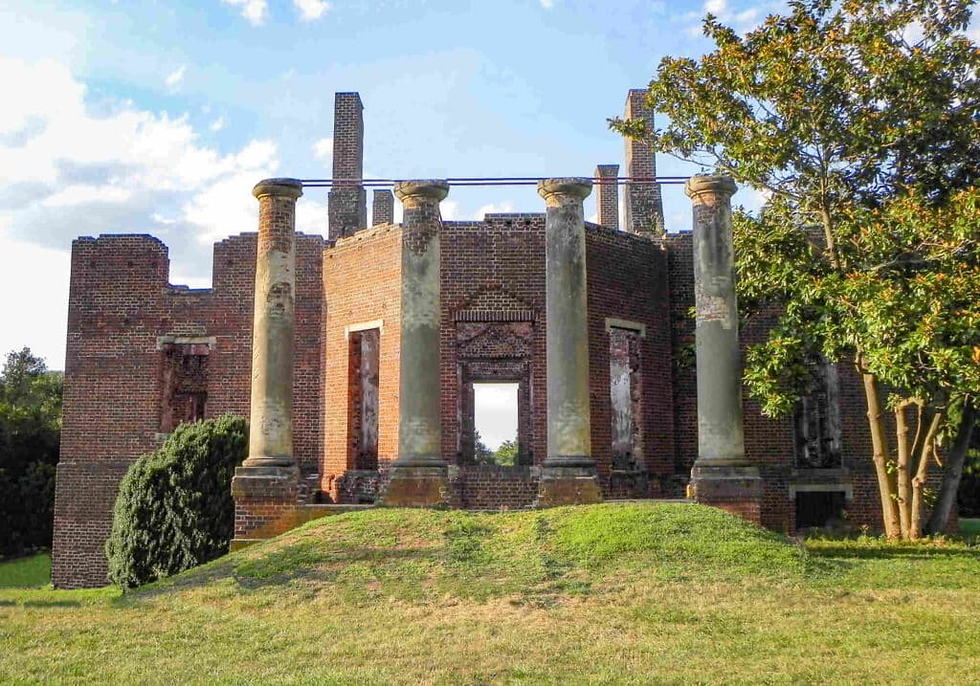
There’s no polished mansion tour, no velvet ropes, no rooms dressed up to look “colonial.” What remains are brick walls, empty window openings, tall chimneys, fragments of grandeur, and the quiet sense that you’ve walked into a place still holding its breath.
The Rosewell Plantation Ruins in Gloucester County, Virginia, are among the most haunting historic sites in the state. They’re beautiful, but not in a neat or finished way. They’re moving because they’re incomplete. The ruins invite you to imagine the house as it once stood, while also asking you to consider the complicated world that made it possible.
For anyone drawn to Virginia history, old architecture, folklore, or quiet places with a strong mood, Rosewell is the kind of site that stays with you.

The Historical Background of Rosewell Plantation
The Page family, one of Virginia’s most prominent colonial families, built Rosewell Plantation in the early 1700s. The mansion was completed around 1725 and was considered one of the largest and most elegant homes in the American colonies. Its design reflected the wealth and status of its owners, featuring brick construction and intricate detailing that showcased the era’s craftsmanship.
The plantation thrived due to tobacco cultivation, a labor-intensive crop that required a large workforce. This workforce was made up almost entirely of enslaved Africans and African Americans. The wealth generated by Rosewell and similar plantations depended on the forced labor of enslaved people, who endured brutal conditions to sustain the plantation economy.
Slavery’s Role at Rosewell
Slavery was not just a background fact at Rosewell; it was central to its operation. Enslaved people worked in the fields planting, tending, and harvesting tobacco. They also performed skilled labor such as carpentry, blacksmithing, and domestic work within the mansion itself.
Records from the period show that the Page family owned dozens of enslaved individuals. These people lived under harsh conditions, with limited freedom and constant threat of punishment. Their labor created the wealth that allowed the Pages to build and maintain Rosewell’s grandeur.
Virginia's plantation system relied heavily on this exploitation. Enslaved people were considered property, bought and sold at auctions, and separated from family members without regard for their humanity. Rosewell’s history is a stark example of how slavery was embedded in the social and economic fabric of colonial Virginia.
The Lives of the Enslaved at Rosewell
While much of the historical record focuses on the plantation owners, it is crucial to remember the enslaved people who lived and worked at Rosewell. Their stories are often harder to uncover, but no less important.
Enslaved families at Rosewell faced grueling work schedules, poor living conditions, and the constant fear of violence. Despite these hardships, they built communities, preserved cultural traditions, and resisted their oppression in subtle and overt ways.
For example, some enslaved people at Rosewell may have used their skills to negotiate slightly better conditions or to maintain a sense of identity through storytelling, music, and religion. These acts of resilience highlight the human spirit amid slavery's cruelty.
The Decline and Legacy of Rosewell Plantation
Rosewell Plantation suffered a devastating fire in the 19th century, which left the mansion in ruins. However, the site remains a powerful symbol of Virginia’s colonial past and the legacy of slavery.
Today, Rosewell is a historic site that invites visitors to reflect on both the architectural achievements and the human cost behind them. Preservation efforts aim to tell a fuller story, including the experiences of the enslaved people who lived there.
Understanding Rosewell’s history helps illuminate the broader context of slavery in Virginia and the United States. It challenges us to acknowledge past injustices and consider their lasting impact on society.
Architectural Features of the Ruins
Even in ruins, Rosewell Plantation reveals much about 18th-century architecture. The remaining walls stand tall, conveying the mansion’s original scale. The brickwork is notable for its Flemish bond pattern, a style that was both decorative and strong. Large window openings and doorways hint at the mansion’s grand interior spaces.
The ruins layout suggests a symmetrical design, common in Georgian architecture, with a central hall flanked by rooms on either side. Locally sourced materials and the craftsmanship evident in the masonry highlight the resources and skills available to the builders.
The Role of Rosewell in Colonial Society
Rosewell was more than a home; it symbolized power and influence. The Page family played significant roles in Virginia’s political and social life. Family members served in the House of Burgesses and held other important positions. The plantation was a hub of activity, hosting gatherings and serving as a center for managing the estate’s agricultural production.

The plantation’s operation depended on enslaved Africans and African Americans, whose labor was essential but whose stories are often less visible. Understanding Rosewell requires acknowledging this painful aspect of its history and recognizing the contributions and suffering of those who lived in bondage.
Stories Behind the Haunting Legends
Many visitors and locals claim that spirits from its past haunt Rosewell Plantation. These stories often involve apparitions, unexplained sounds, and sudden temperature drops. Some of the most common legends include:
The Lady in White: Several witnesses report seeing a ghostly woman in white wandering the ruins at dusk. Some believe she is a member of the Page family who died tragically.
Phantom Footsteps: Visitors often hear footsteps echoing through the empty halls, even when no one else is around.
Mysterious Lights: Visitors have spotted flickering lights and orbs near the ruins, especially on foggy nights.
Whispers and Voices: Some claim to hear faint whispers or voices calling out from the ruins, adding to the eerie atmosphere.
These stories have been passed down through generations, blending historical facts with folklore. While some dismiss these tales as imagination, others find them compelling enough to visit the site in search of paranormal experiences.
Paranormal Investigations and Visitor Experiences
Over the years, paranormal investigators have studied the Rosewell Plantation Ruins. Using equipment like EMF detectors, infrared cameras, and audio recorders, they seek evidence of supernatural activity. Some investigations have captured unexplained sounds or temperature fluctuations, though definitive proof remains elusive.
Visitors often share their own experiences, ranging from feelings of unease to sightings of shadowy figures. These personal accounts add to the ruins' mystique and encourage others to explore the site with an open mind.

Reflecting on the Haunting Legacy
The Rosewell Plantation Ruins stand as a powerful symbol of history and mystery. The haunting legends enrich the site’s story, inviting visitors to connect with the past in a unique way. These tales remind us that history is not just dates and facts, but also the human experiences that shape a place.
Exploring Rosewell offers more than a glimpse into colonial architecture; it opens a door to stories that linger in the shadows. Whether you visit for history, ghost stories, or both, the ruins leave a lasting impression.
Take the opportunity to explore Rosewell Plantation Ruins yourself. Walk among the crumbling walls, listen to the whispers of the past, and decide what you believe about the haunting legends that continue to captivate so many.
Visiting the Rosewell Plantation Ruins Today
Today, the Rosewell Plantation Ruins are open to the public as a historic site. Visitors can walk among the remains, imagining the mansion’s former grandeur while reflecting on the lives connected to the estate. Interpretive signs provide historical context and highlight key features of the ruins.
The surrounding landscape adds to the experience, with views of the York River and the natural environment that shaped the plantation’s economy. The site draws history enthusiasts, students, and anyone interested in early American architecture and colonial life.
Preservation Efforts and Challenges
Preserving the Rosewell Plantation Ruins remains challenging. Exposure to the elements continues to wear down the brick walls, and stabilizing the structure requires careful planning. Preservationists aim to maintain the site’s authenticity while making it safe and accessible for visitors.
Community involvement and support from historical organizations have been crucial in these efforts. Educational programs and events raise awareness of the importance of preserving such sites, ensuring Rosewell’s stories continue to be told.
What Rosewell Teaches Us About the Past
Exploring Rosewell Plantation Ruins offers lessons about ambition, wealth, and the complexities of colonial America. The site embodies the contradictions of a society that built impressive structures and political institutions while relying on enslaved labor.
Visitors can reflect on how history is preserved and interpreted, considering whose stories are told and whose are overlooked. Rosewell encourages a deeper understanding of the past and prompts questions about heritage, memory, and justice.
Planning Your Visit to Rosewell
If you plan to visit the Rosewell Plantation Ruins, consider the following tips:
Check the site’s official hours and any special events or guided tours.
Wear comfortable shoes suitable for walking on uneven terrain.
Bring water and sun protection, especially in warmer months.
Take time to read the informational signs to enrich your experience.
Respect the site by not climbing on the ruins or disturbing the area.
Visiting Rosewell is not just a walk through old bricks; it is an opportunity to connect with history tangibly.
FAQ
Where are the Rosewell Plantation Ruins located?
The Rosewell Plantation Ruins are in Gloucester County, Virginia, in the Tidewater region. The site is associated with the historic Page family and sits in a rural setting shaped by woods, fields, and nearby waterways.
Who built Rosewell Plantation?
Mann Page I, a wealthy colonial Virginia planter, began building Rosewell in the early 1700s. The Page family became one of the most prominent families in colonial and early American Virginia.
Did Thomas Jefferson really write the Declaration of Independence at Rosewell?
A long-standing tradition holds that Thomas Jefferson visited Rosewell and may have drafted or discussed early ideas connected to the Declaration there. The story is part of local lore, but historians treat the exact claim with caution.
What happened to the Rosewell mansion?
A fire destroyed the mansion in 1916. The brick shell survived, creating the dramatic ruins visitors see today.
Is Rosewell worth visiting?
Yes, especially if you enjoy Virginia history, ruins, architecture, photography, or quiet historic places. Rosewell offers a rare mix of scenic beauty, colonial history, folklore, and reflection.
See what the ruins still have to say
Rosewell isn’t a place that hands you one simple story. It gives you pieces: brick, sky, names, legends, silence, beauty, loss. Then it lets you put them together.
That’s what makes a visit so rewarding. The ruins don’t feel frozen. They feel present.
If you’re planning a trip through Virginia’s historic Tidewater region, make time for Rosewell. Walk slowly. Look closely at the brickwork. Listen to the quiet. Think about the people who built, owned, labored at, visited, preserved, and remembered this place.
Some historic sites explain the past. Rosewell lets you feel it.
Because of the scams going on with Airbnb and Vrbo, I will not recommend places listed here on my blog. Here are links to a couple of cases if you would like to read them.
Places to Stay:
You can show your appreciation with a virtual coffee if you have found value in my blog.

Do not forget to subscribe to get my monthly newsletter.
Some links on my website are affiliate links. I earn from qualifying purchases as an Amazon Associate and an Expedia Associate. Through other links, I may also receive a small commission at no extra cost to you. Using them supports me, helps offset the cost of running this website, and ensures I can keep providing free content and resources.
I truly appreciate the support!

Comments