


Haunted Showmen’s Rest in Chicago, Illinois: Dark History of Circus Graves, and Local Legends

If you enjoy this blog post, consider subscribing to get my newsletter.
Comments are always welcome and appreciated.
Walk into Woodlawn Cemetery in Forest Park, just outside Chicago, and you’ll find a graveyard within a graveyard. The markers sit close together. The names are sometimes missing. Stone elephants stand watch, their trunks lowered like they’re mourning something they still remember.
This is Showmen’s Rest, one of the strangest and saddest burial plots in the Chicago area. It’s tied to a circus train wreck, a fire in the dark, unidentified performers, and more than a century of ghost stories.
Plenty of cemeteries feel quiet. Showmen’s Rest feels like the show ended too suddenly.

Showmen’s Rest sits in the shadow of Chicago circus history.
Showmen’s Rest is located in Woodlawn Cemetery in Forest Park, Illinois, a suburb west of Chicago. It belongs to the long, complicated world of circus people, carnival workers, animal handlers, roustabouts, performers, and staff who spent their lives moving from town to town.
The plot is connected to the Showmen’s League of America, an organization formed in the early 1900s to support people in the outdoor amusement business. The League purchased burial space for members and, after tragedy struck in 1918, the plot became a final resting place for many victims of one of the deadliest circus disasters in U.S. history.
That’s what gives the site its strange pull. It isn’t just a cemetery attraction. It’s a memorial to working people who lived behind the spotlight.
The circus has always had two faces. One is bright, loud, and full of wonder. The other is hard travel, little sleep, dangerous work, and lives spent on the rails. Showmen’s Rest holds both.
The stone elephants are the first thing most visitors notice. They’re not playful circus decorations. They look solemn. Heavy. Watchful. They mark the burial ground like guards from another world.
And then there are the names, or the lack of them.
Some graves have full names. Others are marked with descriptions, nicknames, or painfully thin clues. Seeing “Unknown Male” or a nickname like “Baldy” on a headstone hits differently when you realize the person may have had no family nearby, no papers left intact, and no one able to claim them after the wreck.
That’s where the history turns darker.

The 1918 Hagenbeck-Wallace circus train wreck changed everything.
The event that made Showmen’s Rest famous happened before dawn on June 22, 1918.
The Hagenbeck-Wallace Circus was traveling by train through northwest Indiana, headed toward a performance date. Circus trains were moving cities in those days. They carried performers, animals, workers, tents, costumes, props, and the hidden machinery of a traveling show.
Near Hammond, Indiana, one of the circus train sections had stopped on the tracks. Another train, often described as an empty troop train, came up behind it. Its engineer failed to stop in time. The collision crushed wooden sleeping cars filled with circus workers.
Then fire broke out.
The wreck was horrific. Many of the victims were asleep when the train hit. The wooden cars burned fast. Kerosene lamps and splintered wreckage made escape nearly impossible for some inside. By the time rescuers reached the scene, dozens were dead, and many others were injured.
Accounts vary a little on the final count, but the disaster killed roughly 86 people and injured many more. It remains one of the worst circus train wrecks in American history.
Part of what made the aftermath so heartbreaking was identification. Circus people often traveled under stage names. Some workers had no identification on them. Fire destroyed records and belongings. Injured survivors tried to identify friends and coworkers, but in several cases, nobody could say for sure who had died.
The Showmen’s League helped arrange burials at Woodlawn Cemetery. Many of the victims were laid to rest in what became Showmen’s Rest.
That’s why the place carries such a haunted feeling. The dead weren’t soldiers in a battlefield cemetery. They weren’t a family plot with generations of names carved in stone. They were people from a traveling world, stopped in the middle of motion.
One day they were headed to the next town. The next, they were under Chicago-area soil.

The graves tell stories in fragments.
A walk through Showmen’s Rest can feel like reading the torn pages of a book.
Some markers list ordinary names. Others preserve circus nicknames or identifying details, the kind of scraps people used when real names were lost. These markers are among the reasons the site stays in people’s minds long after they leave.
Among the most discussed graves are those marked for unknown victims. The stones may not offer much, but that silence says a lot. In a business built on applause and spectacle, many of the people who made the show possible died almost anonymously.
There are markers known by nicknames such as “Baldy” and “Smiley.” Those names sound almost cheerful until you see them in stone. Then they feel painfully intimate, as if someone were trying to hold on to the only piece of their identity they had left.
Other markers refer to job roles or partial descriptions. That matters because a circus needed far more than famous performers. It needed drivers, cooks, animal handlers, canvas workers, musicians, mechanics, ticket sellers, and people who could build a tent city overnight and tear it down before sunrise.
The dead at Showmen’s Rest represent that whole hidden world.
Joseph Coyle and other remembered names
One name often linked to the tragedy is Joseph Coyle, a clown with the Hagenbeck-Wallace Circus. Coyle has become one of the more recognizable figures connected with Showmen’s Rest, partly because clowns already occupy such a strange place in the public imagination. They’re meant to make people laugh, yet their makeup can feel mask-like, even ghostly, especially in a cemetery.
Other victims included performers and workers from different parts of the circus operation. Some had public-facing roles. Many did not. The plot reminds you that circus history isn’t only about star aerialists, animal acts, and ringleaders. It’s also about exhausted laborers sleeping in railcars after long nights of work.
Showmen’s Rest later became a burial place for others connected to traveling shows and outdoor amusements, not only the wreck victims. Over time, it grew into a broader memorial for show people, a rare place where a profession with few permanent roots found a permanent home.
That’s part of its significance. Circus and carnival workers lived in motion. Showmen’s Rest gave them a fixed point on the map.

Why the elephants feel so eerie
If you’ve seen photos of Showmen’s Rest, you probably remember the elephants.
They’re stone figures, placed around the Showmen’s Rest plot, and they give the site its unforgettable look. Elephants were a powerful circus symbol in the early 20th century. They meant spectacle, strength, and the exotic promises that circuses used to sell tickets. At Showmen’s Rest, though, they don’t feel like advertisements. They feel like mourners.
Their lowered trunks are often read as a sign of grief, though interpretations vary. Either way, the effect is hard to shake. They stand as if the circus animals themselves came to pay respects.
There’s something especially unnerving about circus imagery in a cemetery. A big top is supposed to be temporary, colorful, and loud. A cemetery is permanent, gray, and quiet. Put those worlds together and the mood shifts.
That contrast is why Showmen’s Rest has become such a magnet for people interested in haunted places. It already looks like the setting for a ghost story before anyone tells you one.
But the eeriness isn’t only visual. It comes from what the elephants suggest.
A circus is remembered through its symbols: animals, clowns, music, painted wagons, bright posters. Showmen’s Rest strips those symbols of their cheer. The elephants don’t announce a parade. They stand over the people who never made it to the next performance.
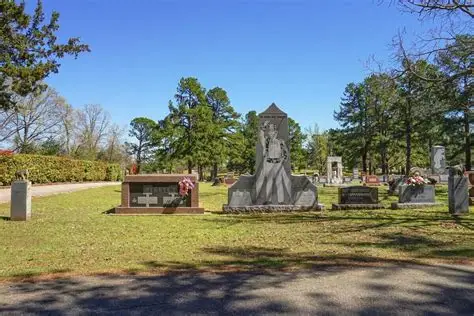
Local legends keep the circus from going quiet.
Like many places tied to sudden death, Showmen’s Rest has gathered ghost stories.
Locals and paranormal enthusiasts have reported all kinds of strange experiences over the years. Some say they’ve heard faint circus music near the plot when no one else was around. Others describe the far-off sound of a calliope, the steam-whistle organ often associated with old circus parades.
People have also reported smelling smoke, sawdust, or animals near the graves. Those details make the stories feel specific. A random chill is one thing. The scent of fire near the burial place of train wreck victims is another.
Then there are the apparition stories.
Visitors have spoken of shadowy figures moving between the stones. Some describe a man in old-fashioned circus clothing. Others claim to have seen clown-like figures near the elephant statues. The classic version of the legend says that, if you visit at the right time and listen closely, you might hear the ghostly sounds of a circus that never finished its route.
Are these stories proven? No. Cemetery legends rarely are.
But Showmen’s Rest is the kind of place where the mind doesn’t have to work hard to imagine them. The facts are already unsettling. People died in their sleep. Some were burned beyond recognition. Some were buried under nicknames because nobody knew what else to call them. Add a quiet cemetery, stone elephants, and the weight of old tragedy, and the ghost stories almost write themselves.
A common local idea is that the performers are still waiting for the next show. It’s a romantic version of the haunting, but there’s sadness underneath it. These were people whose lives revolved around movement. In the legend, even death didn’t convince them the tour was over.
The “phantom circus” feeling
The most powerful stories about Showmen’s Rest don’t always involve a visible ghost. Sometimes people describe a mood.
They’ll say the air feels heavier near the circus graves. They’ll say the place gets unusually still. They’ll mention the sense of being watched, especially near the elephants.
That kind of haunting is harder to dismiss, because it doesn’t depend on seeing a transparent ringmaster floating between headstones. It’s about atmosphere. And Showmen’s Rest has atmosphere to spare.
Think about what the site asks you to hold in your head at once:
The joy people felt watching the circus arrive in town
The danger and exhaustion behind that joy
The violent crash before sunrise
The unidentified dead
The stone elephants standing guard
The legends of music, smoke, and figures in the dark
That mix is why the Haunted Showmen’s Rest Chicago Dark History of Circus Graves and Local Legends continues to attract curious visitors, history lovers, and ghost hunters alike.

Visiting Showmen’s Rest with respect
Showmen’s Rest is a real burial site, not a haunted attraction. That matters.
If you visit Woodlawn Cemetery, treat the plot with the same respect you’d give any grave. Walk carefully. Don’t climb on the monuments. Don’t leave trash. Don’t try to provoke spirits or turn the place into a performance. The people buried there already gave enough to the show.
A good visit is quiet and observant. Read the stones. Notice the words that are missing. Spend a few minutes with the elephants. Let the history do its work.
The best way to experience Showmen’s Rest is to remember both halves of the story. Yes, it’s eerie. Yes, the legends are part of its appeal. But the real history is more affecting than any campfire tale.
These were not imaginary circus ghosts. They were workers, performers, friends, and coworkers. Some were known by name. Some were known only by a nickname. Some were never truly known at all.
That’s why Showmen’s Rest has lasted in Chicago-area memory for more than a century. It gives the forgotten a place to be found.

FAQ
Where is Showmen’s Rest located?
Showmen’s Rest is in Woodlawn Cemetery in Forest Park, Illinois, just west of Chicago. It’s a special burial plot connected to the history of the circus and outdoor show.
What happened to the circus performers buried there?
Many of the graves are connected to the 1918 Hagenbeck-Wallace Circus train wreck near Hammond, Indiana. A train struck stopped circus cars before dawn, causing a deadly crash and fire.
Why are there elephant statues at Showmen’s Rest?
The elephants mark the Showmen’s League burial plot and reflect the circus world connected to the people buried there. Their solemn appearance has made them one of the site’s most memorable features.
Is Showmen’s Rest really haunted?
There’s no proof that it’s haunted, but many local legends describe strange sounds, shadowy figures, ghostly circus music, and the smell of smoke or sawdust near the graves.
Can you visit Showmen’s Rest?
Yes, visitors can visit Woodlawn Cemetery during open hours, but it’s still an active burial and remembrance site. Be quiet, respectful, and careful around the graves and monuments.
The circus ended, but the story stayed.
Showmen’s Rest is haunting because it doesn’t need much decoration. The graves, the elephants, and the history are enough.
It’s a place where circus wonder meets real disaster. It reminds us that behind every bright tent were people doing hard, risky work far from home. Some died with their names intact. Others became “Unknown” or were remembered by a nickname carved into stone.
The local legends add a chill, but the deeper mystery is human. Who were they? Who loved them? What jokes did “Smiley” tell? What did “Baldy” do before the fire took everything but a nickname?
That’s the thing about Showmen’s Rest. You can go for the ghost stories, but you’ll leave thinking about the people. The show moved on without them, as shows do. Yet in a quiet cemetery outside Chicago, the stone elephants still keep watch.
There are many scams on Airbnb and Vrbo; I will not recommend places listed here on my blog. Here are links to a couple of cases you can read if you would like.
Places to Stay:
You can show your appreciation with a virtual coffee if you have found value in my blog.

Some of the links found on my website are affiliate links. I earn from qualifying purchases as an Amazon Associate and an Expedia Associate. Through other links, I may also receive a small commission at no extra cost to you. Using them is a way to support me, help offset the cost of running this website, and ensure I can continue providing free content and resources.
I truly appreciate the support!


Comments