


How Long Does Mail Take to Reach Asia From Your Home Country

If you enjoy this blog post, consider subscribing to get my newsletter.
Comments are always welcome and appreciated.
Sending mail to Asia can feel a little like dropping something into a tunnel and hoping it pops out on the other side. Most of the time, it does. But the timing can vary a lot depending on what you're sending, which country it's going to, whether customs gets involved, and how much you’re willing to pay.
A birthday card to Japan might arrive in a week. A package to a smaller city in Indonesia or India could take several weeks. An express courier document may arrive in Singapore in two business days, while a low-cost parcel can sit in customs long enough to test your patience.
The good news is that international mail is pretty predictable when you choose the right service, pack well, and track it properly. This guide walks through typical delivery times, common problems, carrier options, packaging tips, and the small steps that make a big difference.
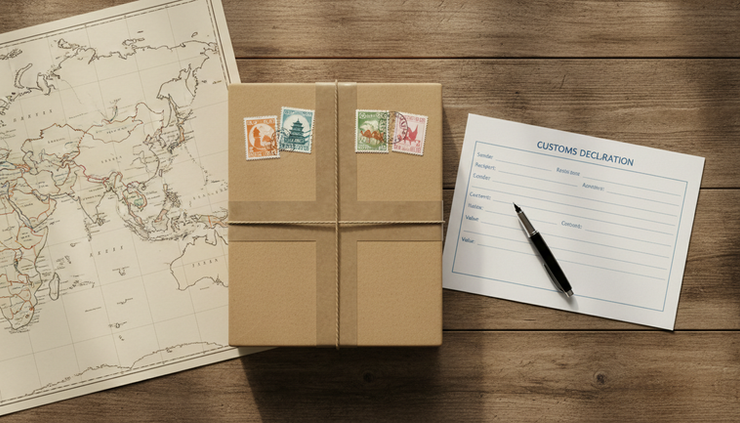
How Long Does Mail Take to Reach Asia? Delivery times depend mostly on the service you choose
The mail service is the biggest factor. Destination matters too, but service level usually sets the range.
How Long Does Mail Take to Reach Asia? A package going to Tokyo, Seoul, Singapore, or Hong Kong will often move faster because those places have major airports, strong postal systems, and frequent cargo flights. Mail going to rural areas, islands, mountain regions, or smaller towns usually needs more handoffs, which adds time.
Here’s a practical guide to average delivery windows. These are general estimates, not promises. Weather, holidays, customs, and local delivery conditions can all change the timeline.
The table below provides guidelines to help you gauge timing. Weather also plays a major role because of monsoons, typhoons, and cyclones. For example, I sent a letter from the United States to the Philippines in mid-March. Six months later, I still haven't received it. So I would say instead of weeks, I would also add never.
Mail service | Typical delivery time to Asia | Best for | Tracking |
Standard international letter mail | 1 to 3 weeks | Cards, letters, lightweight documents | Often limited or unavailable |
Registered international mail | 2 to 4 weeks | Important letters that need proof of mailing | Usually available, but can be slow to update |
International economy parcel | 2 to 8 weeks | Non-urgent packages | Varies by country and carrier |
Postal express mail or EMS | 3 to 10 business days | Faster documents and parcels | Usually included |
Private courier express | 2 to 5 business days | Urgent documents, valuable items, business shipments | Strong tracking |
Freight or sea mail, where available | 1 to 3 months or more | Large, heavy, non-urgent shipments | Varies widely |
If you’re mailing from the United States, USPS First-Class Mail International is often the cheapest option for letters and small items, but tracking can be limited. USPS Priority Mail International and Priority Mail Express International usually move faster and include better tracking. Private couriers like DHL, FedEx, and UPS cost more, but they tend to offer clearer tracking, faster transit, and stronger support if something goes wrong.
For many everyday shipments, the sweet spot is this:
Cards and casual letters
Standard international letter mail is usually fine if it’s not urgent.
Important documents
Use registered mail, postal express, or a private courier. Don’t send original legal, medical, or financial papers without making copies first.
Gifts and personal packages
Postal parcel services work well when you’re not in a rush. Use express if the timing matters.
Time-sensitive items
Choose DHL, FedEx, UPS, or your national postal service’s express option.
The phrase “average delivery time” can be misleading because international shipping has two clocks. The first clock is transportation between countries. The second clock is clearance and local delivery inside the destination country. Delays often happen in the second.
Letters usually move faster than parcels.
Letters and postcards need less processing. If they’re light, flat, and clearly addressed, they often move through the system quickly.
Parcels need more checks. They may require customs forms, screening, sorting by size and weight, and handoff to a local courier or postal office. Even a small gift can take longer than a stack of documents if customs decides to review it.
If you’re sending a greeting card with no valuable items inside, expect roughly 1 to 3 weeks. If you’re slipping in gift cards, jewelry, cash, or small goods, don’t. Those items can violate postal rules, attract theft, or trigger customs problems.
NOTE: If you haven't received a letter within three months in the Philippines, it is a good idea to go to the local post office and inquire. The Philippines tends to hold on to your letters and not deliver them.
Express does not mean customs-proof
Express services are faster because they use priority transport and tighter logistics. They may also handle customs paperwork more efficiently. Still, no carrier can skip customs completely.
A courier can move a package from Los Angeles to Bangkok in two days, then watch it sit while customs asks for more information. That’s not a failure of the flight network. It’s the normal control point for international shipments.
Customs delays are the most common reason mail gets stuck.
Customs is where many international mail surprises happen. Every country has rules about what can enter, what needs inspection, and what taxes or duties apply. Asia isn’t one postal system, of course. Japan, India, Vietnam, China, South Korea, Thailand, the Philippines, Malaysia, Singapore, and Indonesia all have different procedures.
When customs works smoothly, it might add only a day or two. When something looks unclear, incomplete, or restricted, it can add a week or more.

The package description is too vague.
Customs forms need plain, specific descriptions. “Gift” is not enough. “Clothes” is better, but still broad. “Cotton T-shirt” is clearer.
Good descriptions include what the item is made from and what it’s used for.
Instead of writing:
Gift
Personal items
Parts
Accessories
Samples
Write something like:
Cotton baby clothes
Paperback book
Plastic phone case
Handmade wool scarf
Chocolate candy, sealed retail package
This helps customs officers understand the shipment without opening it or asking questions.
The declared value looks wrong.
If you mark a $200 item as worth $5, customs may flag it. If you mark everything as “gift” but the package contains several brand-new items, that can raise questions too.
Use a fair value. It doesn’t need to be the exact retail price down to the penny, but it should be honest. If the item is used, declare a reasonable used value. If it’s handmade, estimate what it would fairly cost to replace.
Lowballing the value can cause:
Delays
Fines or penalties
Confiscation
Insurance problems if the package gets lost
If you insure a package for $300 but declare its customs value as $20, that mismatch can create problems later.
The item is restricted or banned.
Every destination country has its own restricted list. Common problem items include:
Food, especially meat, dairy, seeds, fresh produce, and homemade goods
Medicine, vitamins, and supplements
Cosmetics and skincare products
Batteries and electronics with lithium batteries
Alcohol, tobacco, and vape products
Perfume and other flammable liquids
Plants, soil, seeds, and biological materials
Counterfeit goods or items with trademark issues
Some items can ship legally only with extra paperwork. Others can’t ship at all.
Food is one of the trickiest categories. A sealed box of candy may be fine in one country and restricted in another. Homemade cookies may be refused because ingredients and safety information aren’t clear.
Medicine is another risky one. Even over-the-counter products in your home country may count as controlled or regulated in another country. If someone needs medicine abroad, it’s usually better to check with the destination country’s official guidance before mailing anything.
Holidays can slow everything down.
International mail gets busy around November and December, Lunar New Year, Golden Week in Japan, Diwali, Eid, national holidays, and local shopping events. Airports, customs offices, and local post offices all feel the volume.
If you’re sending holiday gifts to Asia, send early. For standard mail, give yourself at least a few extra weeks. For express mail, don’t assume “three days” during peak season means it will arrive before the celebration.
Local holidays matter too. A package can arrive in the destination country quickly, then wait because local delivery services are closed or working through a backlog.
Address formatting causes more trouble than people expect
A good address is one of the easiest ways to prevent delays. But address formats vary across Asia.
Some countries use postal codes heavily. Some rely on district names, building names, landmarks, or apartment numbers. Some addresses look long because they move from large area to small area, or from small area to large area depending on local custom.
Ask the recipient to write the address exactly how it should appear. If the local language uses non-Latin characters, such as Chinese, Japanese, Korean, or Thai, it’s smart to include both versions:
The address in English or romanized form
The address in the local language, if the carrier accepts it
Put the destination country name in English on the last line. Write it clearly in all caps if you’re handwriting.
Example format:
```text
Recipient Name
Apartment or Building Name
Street or District
City, Province or Prefecture
Postal Code
COUNTRY
Phone Number
```
A phone number is especially helpful for courier shipments. Drivers may call if they can’t find the building or need help with delivery instructions.
Choosing the right carrier can save time and stress.
No single carrier is best for every shipment. The right choice depends on urgency, budget, tracking needs, item value, and destination.
Here’s how to think about the main options.
Your national postal service is usually best for low-cost mail.
For everyday international mail, national postal services are often the most affordable. In the United States, that means USPS. In other countries, it might be Royal Mail, Canada Post, Australia Post, La Poste, Deutsche Post, Japan Post for outbound mail from Japan, or another national carrier.
Postal services hand packages to the destination country’s postal system after arrival. That can work very well, especially for major cities. It can also mean tracking updates slow down after customs or local handoff.
Use postal mail when:
The item is not urgent
The value is low to moderate
You’re sending letters, books, clothing, or simple gifts
You want a lower price
The recipient can easily receive mail from the local post office.
Postal mail is less ideal when timing is critical, or the item is expensive.
EMS is a good middle ground
EMS, short for Express Mail Service, is a global postal express network used by many national postal services. It’s usually faster than standard postal mail and cheaper than many private express couriers.
EMS works well for:
Documents
Gifts
Small parcels
Shipments that need tracking
Packages where speed matters, but cost still matters too
Delivery times vary by route, but many EMS shipments reach major Asian cities within about 3 to 10 business days. Customs can still add time.
Private couriers are best for urgent and higher-value shipments.
DHL, FedEx, and UPS are the common choices when you need speed and end-to-end tracking. They often have strong networks in major Asian cities and clearer delivery scans than postal services. I use DHL because I've had better luck with them regarding arrival times.
Use a private courier when:
The item is urgent
You need detailed tracking
You’re sending business documents
You need stronger customer support
The recipient is in a city with reliable courier access
You’re sending something valuable enough to justify the cost
Private couriers may also collect customs duties, taxes, or service fees before delivery. That can surprise the recipient, so talk about it ahead of time.
If the recipient lives in a remote area, a courier may hand the package to a local partner. That’s normal, but it can add a day or two.
Freight services are for heavy or bulky shipments.
If you’re sending boxes of household goods, large equipment, or multiple heavy parcels, parcel mail may not be the best fit. Air freight is faster but expensive. Sea freight is slower but cheaper for bulk shipments.
For personal mail and gifts, freight is usually too much hassle. For relocation shipments, it can make sense.
Pack and label your mail like it will be handled a lot.
International mail gets touched, scanned, stacked, sorted, moved, and sometimes opened for inspection. Good packaging protects the item and keeps the label readable.
A package doesn’t need to look fancy. It needs to survive the trip.

Use the right outer packaging.
For small, non-fragile items, a padded mailer can work. For anything breakable, use a box.
Choose a box that’s strong enough for the item. Reused boxes are fine if they’re clean, sturdy, and free of old barcodes or labels. Remove or cover anything that might confuse sorting machines.
Avoid boxes that are:
Soft or crushed
Too large for the contents
Covered in old shipping labels
Held together with weak tape
Made for retail display rather than shipping
If the box has space inside, fill it. Items moving around inside the box are more likely to break.
Cushion the contents well.
International packages can go through conveyor belts, trucks, aircraft, customs bins, and local delivery vehicles. Pack as if the box may be turned upside down.
Good cushioning materials include:
Bubble wrap
Packing paper
Foam sheets
Air pillows
Crumpled kraft paper
Corrugated inserts
For fragile items, wrap each piece separately. Leave cushioning on all sides, not just the top. A common rule is to keep at least 2 inches of cushioning around fragile goods.
If you’re sending liquids that are allowed by the carrier and destination country, seal them in leakproof bags before placing them in the box. Many liquids are restricted, so check before mailing.
Tape every opening
Use packing tape, not gift wrap tape or masking tape. Seal the center seam and the side seams. For heavier packages, use the H-taping method: tape the main opening and both edge seams so the box stays closed under pressure.
Don’t wrap the box in paper or string. Paper can tear off during sorting, and string can get caught in machines.
Protect the label
Print the label if you can. If you handwrite it, use dark ink and clear block letters.
Make sure the label includes:
Recipient’s full name
Full street address or local equivalent
Apartment, unit, floor, or building name
City and region
Postal code
Country
Recipient phone number, especially for courier delivery
Return address
Place the label on the largest flat side of the package. Cover it with clear tape or a label pouch, but don’t tape over barcodes if the tape creates glare or wrinkles.
Put a second copy of the address inside the package. If the outside label gets damaged, this gives the carrier a backup.
Be careful with gifts.
Gift wrap looks nice, but it doesn’t belong on the outside of an international package. It tears too easily. If you want the item to feel special, wrap it inside the shipping box.
Also, don’t assume marking something as a gift means it won’t be taxed. Many countries still charge duties or taxes on gifts above certain value limits.
Include a simple note inside if you want, but keep the customs form practical and honest.
Track your mail and plan for safe delivery.
Tracking is helpful, but it can also be confusing. International tracking often updates in bursts. A package may show no movement for several days, then suddenly scan in the destination country.
That doesn’t always mean it was stuck. It may have been in transit between scan points.
Understand what tracking updates mean
Common tracking messages include:
Accepted or received
The carrier has the item.
Processed through facility
The item moved through a sorting center.
Departed country of origin
The shipment left your home country or is waiting for outbound transport.
Arrived in destination country
The package reached its destination country.
Held in customs
Customs is reviewing the package or waiting for information.
Released from customs
Customs cleared it and sent it back into the delivery network.
Out for delivery
The local carrier plans to deliver it soon.
Delivery attempted
The driver or postal worker tried to deliver it but couldn’t complete delivery.
The “held in customs” message is the most worrying. In many cases, it’s routine. If it lasts more than a few business days, the recipient may need to contact the local post office, courier, or customs office.
Track through both carriers.
For postal shipments, you can often track the package through your home carrier first, then through the destination country’s postal service after it arrives.
For example, a USPS package may show basic updates on USPS.com. Once it reaches South Korea, Japan, Singapore, or another destination, the local postal site may show more detail.
Try this flow:
Track on the original carrier’s website.
Copy the tracking number.
Search for the destination country’s postal tracking page.
Enter the same tracking number there.
Ask the recipient to check local notices, text messages, or missed delivery slips.
Private couriers usually keep tracking on one platform, though local partner deliveries can still create gaps.
Share tracking details with the recipient.
This sounds obvious, but it helps a lot. Send the recipient:
Tracking number
Carrier name
Shipping date
Declared contents
Declared value
Estimated delivery window
Any customs or delivery instructions
If duties or taxes are likely, tell them before the package arrives. Some couriers won’t deliver until the recipient pays online or at the door.
Watch for missed delivery attempts.
In many Asian cities, deliveries happen quickly once a package clears customs. In apartment buildings, dorms, gated communities, or rural areas, missed deliveries are common.
The recipient should watch for:
Phone calls from unknown local numbers
Text messages from the carrier
Delivery notices in the mailbox
Tracking updates that say delivery was attempted
Requests for ID or tax payment
If a package sits unclaimed, the carrier may return it to sender. International returns can take a long time and may cost extra.
Insure valuable items
If you’re sending something expensive, insure it if the carrier offers insurance. Keep the receipt, tracking number, and proof of value.
Insurance does not prevent loss or damage, but it gives you a path to file a claim. Make sure your declared value, insurance amount, and item description match.
Some items may be excluded from insurance. Cash, jewelry, collectibles, electronics, and fragile goods often have special limits or rules. Read the carrier’s terms before mailing.

A simple plan for sending mail to Asia without headaches
If you want the smoothest experience, don’t start by asking only, “What’s the cheapest option?” Start with what happens if the package arrives late, gets stuck, or needs extra paperwork.
For casual mail, cheap is often fine. For documents, gifts, electronics, or anything with real value, a better service can save a lot of stress.
Here’s a simple process that works for most shipments.
Step 1. Confirm the destination address
Ask the recipient to send the address in the exact format they use locally. If possible, get it in both English and the local language.
Check the postal code. Confirm the phone number. Make sure the country name is clear.
Step 2. Check restrictions before you pack
Before buying supplies or sealing the box, check whether the destination allows the item. Look at both the carrier rules and the destination country rules.
Pay special attention to:
Food
Medicine
Cosmetics
Batteries
Liquids
Seeds and plants
Alcohol
Tobacco
High-value electronics
If you’re unsure, ask the carrier before shipping. It’s better to find out at the counter than after the package reaches customs.
Step 3. Choose the service based on urgency
Use standard mail for simple, low-value items with flexible timing. Use express postal service or EMS when you need faster delivery at a moderate cost. Use DHL, FedEx, or UPS when the shipment is urgent, valuable, or needs strong tracking.
For most people asking how long mail takes to reach Asia from your home country, the honest answer is this: plan on 1 to 3 weeks for regular letters, 2 to 8 weeks for economy parcels, and 2 to 10 business days for express services.
That range may feel wide, but it’s realistic.
Step 4. Fill out customs forms clearly
Use specific descriptions. Declare a fair value. Mark the correct category, such as gift, document, merchandise, or returned goods.
Don’t try to be clever with customs. Clear and boring is best.
Step 5. Pack for a long trip
Use strong packaging, enough cushioning, and proper tape. Put the address on the inside and outside. Don’t use decorative wrapping on the outside.
If the item is fragile, take photos before shipping. Photos can help if you need to file an insurance claim.
Step 6. Keep every receipt
Until the package arrives, keep:
Mailing receipt
Tracking number
Customs form copy
Insurance receipt
Photos of the package
Proof of item value
If something goes wrong, these records make the process much easier.
Step 7. Follow the tracking, but don’t panic over quiet periods
No scan for a few days is normal, especially after export or during customs processing. Start asking questions when the package is past the expected delivery window or stuck on the same status for a long time.
For postal mail, contact the sender’s postal service first. For courier shipments, either the sender or recipient can usually contact customer service, but the account holder may get more detailed help.
FAQ
How long does a regular letter take to reach Asia?
A regular international letter often takes about 1 to 3 weeks. Major cities may receive mail faster, while remote areas or peak holiday periods can take longer.
Is DHL, FedEx, or UPS faster than the post office?
Usually, yes. Private couriers often deliver to major Asian cities in about 2 to 5 business days, not counting customs delays. They also tend to offer more detailed tracking.
Why is my package stuck in customs?
Customs may be checking the contents, value, paperwork, or import rules. The package may also be waiting for duties, taxes, or extra information from the recipient.
Can I send food to Asia by mail?
Sometimes, but food rules vary by country. Sealed commercial snacks may be allowed in some places, while meat, dairy, fresh produce, seeds, and homemade food are often restricted or banned.
What should I do if tracking stops updating?
Give it a few days, especially if the last scan says it left the origin country or entered customs. Then check the destination country’s postal tracking site or contact the carrier with the tracking number.
The best way to avoid surprises
International mail doesn’t have to be stressful. Pick the service that matches the urgency, write the address clearly, complete customs forms honestly, and pack the item like it has a long trip ahead.
If timing matters, pay for tracking and speed. If the item matters, insure it. If customs rules look unclear, check before sending.
A little extra care at the start can save weeks of waiting later, and it gives your mail the best chance of reaching Asia safely and on time.
You can show your appreciation with a virtual coffee if you have found value in my blog.

Don’t forget to sign up for my monthly newsletter.
Some links on my website are affiliate links. I earn from qualifying purchases as an Amazon Associate and an Expedia Associate. Through other links, I may also receive a small commission at no extra cost to you. Using them supports me, helps offset the cost of running this website, and helps me keep providing free content and resources.
I truly appreciate the support!



Comments